
News · Rates · Newcastle + Lake Macquarie
Newcastle’s rates cap is 4.2 per cent. Lake Macquarie’s is 3.2. The gap is how growth gets counted
From 1 July, the pricing regulator lets Newcastle lift its total rates income by more than any other Hunter council, while Lake Macquarie gets one of the smallest increases. Both cities are growing. The difference sits in one column of the regulator’s own table.
Every year the Independent Pricing and Regulatory Tribunal sets a “rate peg” for each of the 128 NSW councils: the most that council’s total general rates income can rise in the coming financial year without a special application. The 2026-27 pegs took effect this week, and across the Hunter they split cleanly in two: councils that got a population top-up, and councils that got none.
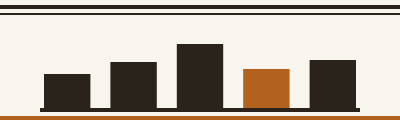
2026-27 rate pegs, Hunter councils
Core rate peg (ink) plus population factor (ochre). Source: IPART, Table 2.
The formula, in one paragraph
Each council’s peg is a core rate (a base cost change of 3.0 per cent for every council this year, adjusted for emergency services levy costs and a few small items) plus a population factor. The population factor is meant to fund growth: it takes the council area’s population growth (measured with a three-year lag, so this year uses 2023 figures) and subtracts the growth in “supplementary valuations”, which is new rateable property, like subdivided lots and new builds, that has already been added to the council’s rating base during the year. If the result is negative, it is set to zero, never below.
That subtraction is the whole Newcastle–Lake Macquarie story:
Why one city gets a population factor and the other doesn’t
IPART, Table 2, 2026-27. Population growth is lagged three years.
| Council | Population growth | less: new property already in the rate base | = population factor |
|---|---|---|---|
| Newcastle | 1.5% | 0.3% | 1.2% |
| Lake Macquarie | 1.2% | 1.5% | 0.0% |
| Cessnock | 2.7% | 1.9% | 0.8% |
| Maitland | 2.3% | 2.2% | 0.1% |
| Port Stephens | 1.5% | 0.4% | 1.1% |
Read as the regulator intends it: Lake Macquarie’s growth is arriving as new rateable properties, which started paying rates the moment they were valued, so in IPART’s model the growth has already paid its way. Newcastle’s population grew faster than its rating base did, so it gets topped up. Maitland is the sharpest case in the Hunter: the fastest population growth of the five Lower Hunter councils (2.3 per cent), and almost all of it already in the rate base, leaving a factor of just 0.1.
Two footnotes worth knowing
First, Lake Macquarie’s core peg (3.2 per cent) is actually higher than Newcastle’s (3.0 per cent), mostly through emergency services levy adjustments, so the headline gap of one percentage point is entirely the population factor and then some. Second, Lake Macquarie City Council has publicly criticised this methodology before: in an earlier rate-peg cycle it argued the formula under-compensates growing councils, as reported by the Newcastle Herald in 2023. That criticism predates these numbers; we have found no council statement yet on the 2026-27 peg specifically.
What a peg is not
The peg caps a council’s total general rates income, not your individual bill, which also moves with land valuations and rating categories. And it is not the last word: a council can apply to IPART for a special variation above the peg. Neither Newcastle nor Lake Macquarie has a 2026-27 special variation listed as of publication.
Spotted an error in this story? Ask for a correction. Corrections are published, dated and left visible.